
Introduction
In dual credit or dual enrollment programs, high school students can take college classes and simultaneously earn both high school and college credit. Taking college classes in high school prepares students academically for college work, and earning college credits in high school may reduce college costs. Nationally, dual credit participation in public 4-year institutions more than tripled from 1995 to 2015 (from 72,000 to 220,000 students) (Marken et al., 2013). As of spring 2012, only 8% of students took dual credit classes online; most students took these courses at their own high school (National Center for Education Statistics, 2019a). Past research concerning online learning shows that schools—particularly high schools—had increased their offerings of online learning courses prior to the COVID-19 pandemic (Gemin et al., 2015). However, studies of the outcomes of online learning have been mixed with some finding higher grades in online classes while others find lower grades in online classes (Tate & Warschauer, 2022).
However, in spring of 2020, educators and students across the world had to rapidly transition to online learning because of the COVID-19 pandemic. During the COVID-19 pandemic, the abrupt shift of millions of students and teachers to online learning meant that students and instructors struggled if they did not have access to up-to-date computers, broadband internet, or skills needed to conduct online classes effectively or to succeed when taking these courses. For students in dual credit programs, this shift was particularly complicated because they simultaneously held status and responsibilities as high school and college students.
This brief examines the transition to online learning for the dual credit program in Hawaiʻi, which had expanded dramatically in the decade before COVID-19. For the class of 2011, only 5% of those who finished public high school had graduated with dual credit. For the class of 2019, 22% did (Hawaiʻi P-20 Partnerships for Education, 2020). Before the COVID-19 pandemic, all dual credit classes met at the students’ high schools, and all had to rapidly switch to online learning in spring 2020. For the Research Corporation of the University of Hawaiʻi, RTI evaluated this rapid transition to online learning. RTI’s multi-method analysis involved analyzing data from the state longitudinal data system from summer 2018 through spring 2021, conducting online surveys of the University of Hawaiʻi’s instructors and high school program coordinators and administering focus groups of college instructors and high school staff involved with the program.
Overall Response to the Transition to Online Learning in Dual Credit Courses
Before the onset of the COVID-19 lockdowns, dual credit had been expanding in Hawaiʻi. In fall 2018, 168 dual credit courses were offered, with 2,265 students enrolling. By spring 2020, 216 dual credit courses were offered, with 2,542 students enrolling. (Students would have registered for and begun taking these courses before COVID-19 began.)
Across the country, making a rapid switch to online learning meant teachers and students had to rapidly acquire technological tools and gain skills in teaching and learning online. In our survey of dual credit high school coordinators (detailed survey responses are available from authors), 76% in Hawaiʻi reported that the biggest challenge with this transition was that high school staff had to help students learn how to access and use the learning management platform and software, while they themselves needed support in shifting to online learning. In our survey of dual credit college instructors, 58% reported they needed to develop instructional approaches to ensure that the quality of instruction and student interactions remained consistent with pre-pandemic practices, and 51% indicated they were challenged by addressing students’ technology problems. In spring 2020, when COVID-19 restrictions were in place, course offerings and student enrollments for the following term declined. In fall 2020, the number of offerings decreased to 170 (21 percentage points), and the number of enrolled students declined to 2,079 (18.2 percentage points).
To succeed in gaining both high school and college credit, students needed to earn a grade of C or better in the course. Each term—even during the COVID-19 lockdown in spring 2020—at least 87% of dual credit students earned both high school and college credit by earning a grade of C or better. In fall 2019, the overall success rate was 90%, but it dropped to 87% in spring 2020. In spring 2020, the University of Hawaiʻi system’s emergency grading policy allowed selecting Credit/No Credit for grades, which may have affected the measurement of course success in that term (University of Hawaiʻi System News, 2020).
Dual credit recovery. High schools and colleges continued to collaborate to offer dual credit courses. The number of instructional support staff available to students did not change during this period. In our surveys, respondents could select options describing general successes, and both high school coordinators and university instructors said that college instructors had increased their frequency of notifying the high school when students struggled as one of their successes.
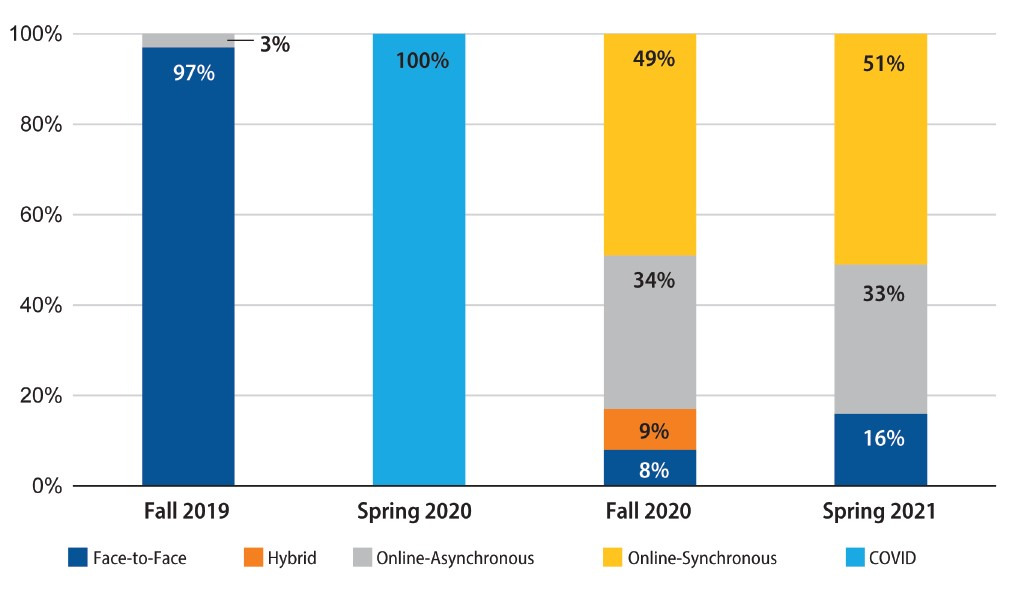
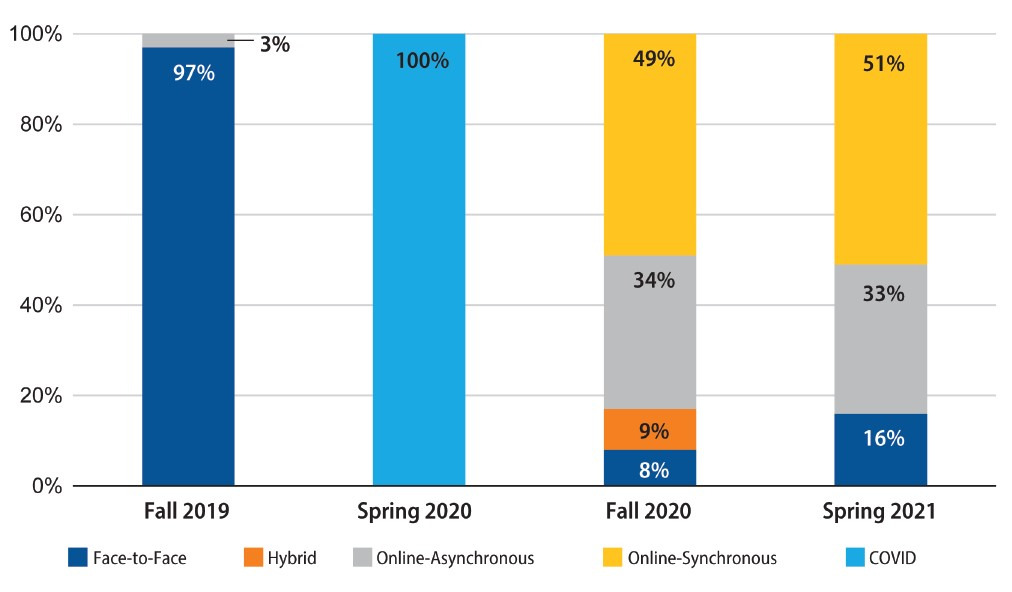
The dual credit course offerings and enrollments recovered by spring 2021, when the number of courses offered had increased by 16 percentage points (170 to 198), which is greater than the numbers in fall and spring 2019. Student enrollment numbers increased by 12 percentage points (2,079 to 2,331) in the spring 2021 term, which led to slightly higher student enrollment numbers than during the 2018–2019 school year. As shown in Figure 1, most dual credit courses in fall 2020 and spring 2021 remained online. In fall 2020, 83% of dual credit courses stayed online (49% synchronous and 34% asynchronous). This trend continued in spring 2021 as 84% of dual credit courses stayed online (51% synchronous and 33% asynchronous).
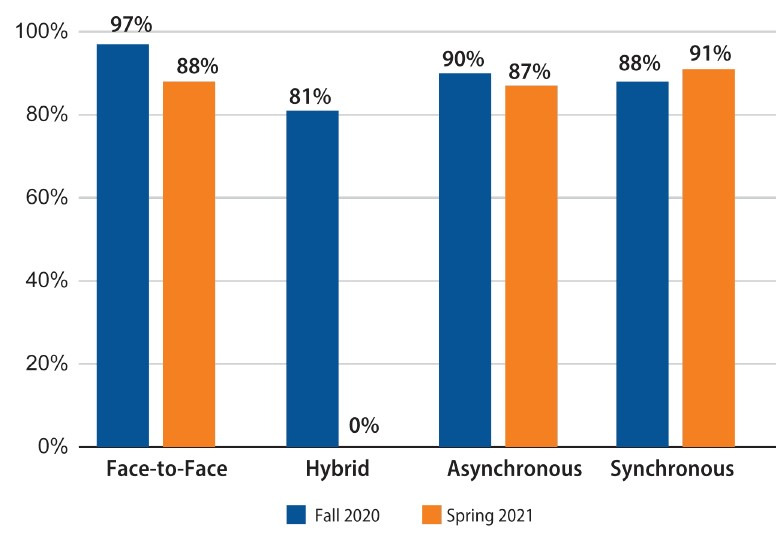
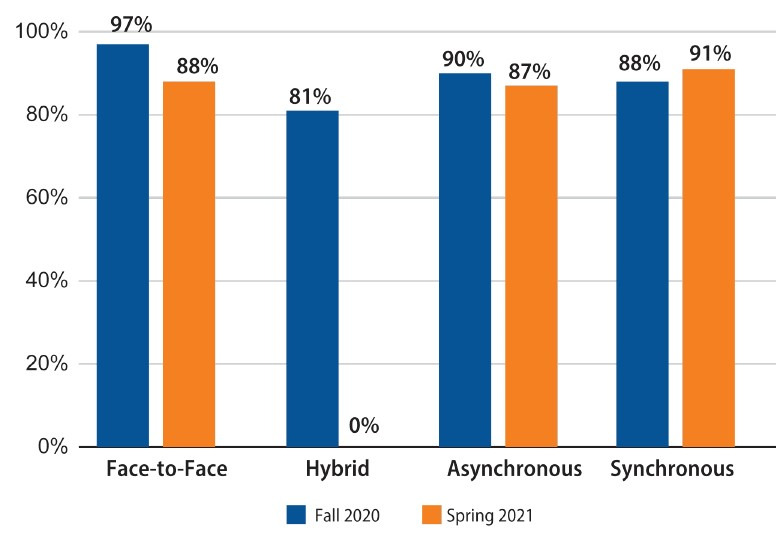
By spring 2021, the percentage of students earning a C or better leveled back out at 89% among all students—the same as fall 2020 and 2 percentage points higher than spring 2020 (detailed results are available from authors). As shown in Figure 2, in fall 2020, students performed best in the dual credit courses that had returned to face-to-face with 97% of students earning a C or better (compared with 81% in hybrid, 90% in asynchronous, and 88% in synchronous). However, by spring 2021, students were performing best in the online synchronous dual credit courses with 91% of students in online synchronous courses earning a C or better (compared with 88% in face-to face and 87% in online asynchronous). No hybrid courses were offered in spring 2021.
Differences in Response to the Transition to Online Learning by Student and School Characteristics
Before spring 2020, some groups of students enrolled in dual credit classes less frequently than others. In 2019, only about one-third of the enrollees were male. This finding is aligned with national results, which show that female students have higher rates of dual credit earning than male students (National Center for Education Statistics, 2019b). When considering locale, rural schools had the lowest rates of enrollment in spring and fall 2019. Only about 11% of enrollees were in rural schools. This rate was less than one-quarter the rate of suburban schools and less than half that of town schools. All courses had college instructors visiting the high schools to teach in person, and participants in RTI’s focus groups noted that this travel requirement could lead to fewer offerings, particularly in rural schools where college instructors may not have been able to travel. Examining Title I schools reveals that a higher percentage of enrollees attended Title I schools (see Table 1) in spring 2019, but non–Title I schools had a higher percentage of attendees by fall 2019.
We examined whether responses to the transition to online learning varied by group. In general, all groups followed a similar pattern of declining enrollments during the lockdown year and a rebound in the following year, but some groups struggled more with enrolling and earning at least C grades during this time.
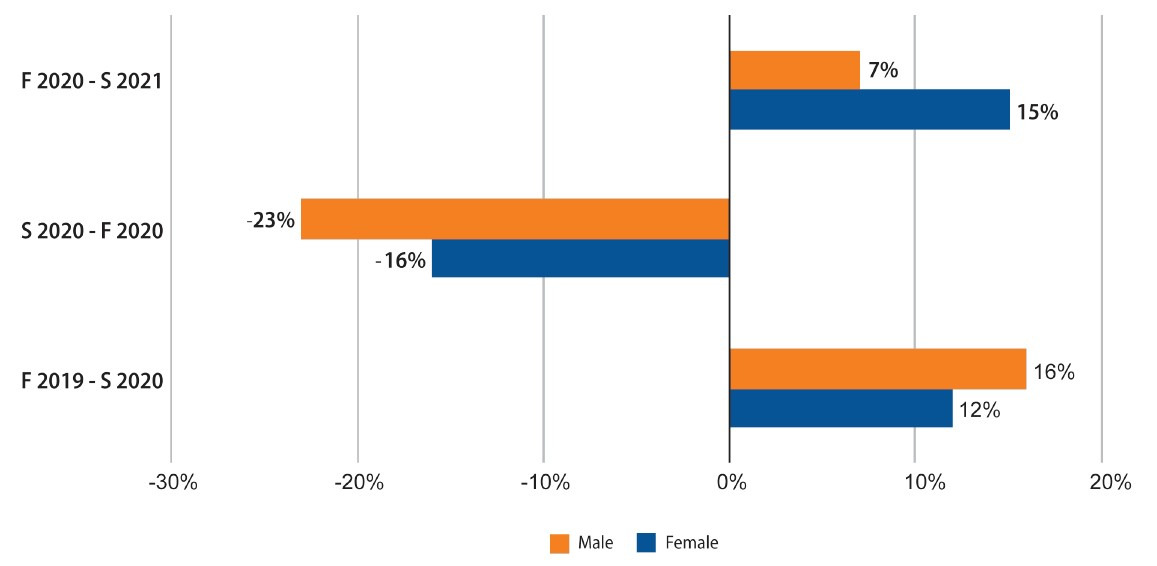
As shown in Table 1, both male and female enrollments increased from fall 2019 to spring 2020, and male enrollment increased more than female enrollment (758 to 882 for male students; 1,482 to 1,660 for female students). During the transition to online learning, both male and female enrollment declined, but male students faced a greater decline. Female enrollment declined 16 percentage points (1,660 to 1,401) compared with a 23 percentage point decline for male students (882 to 678).
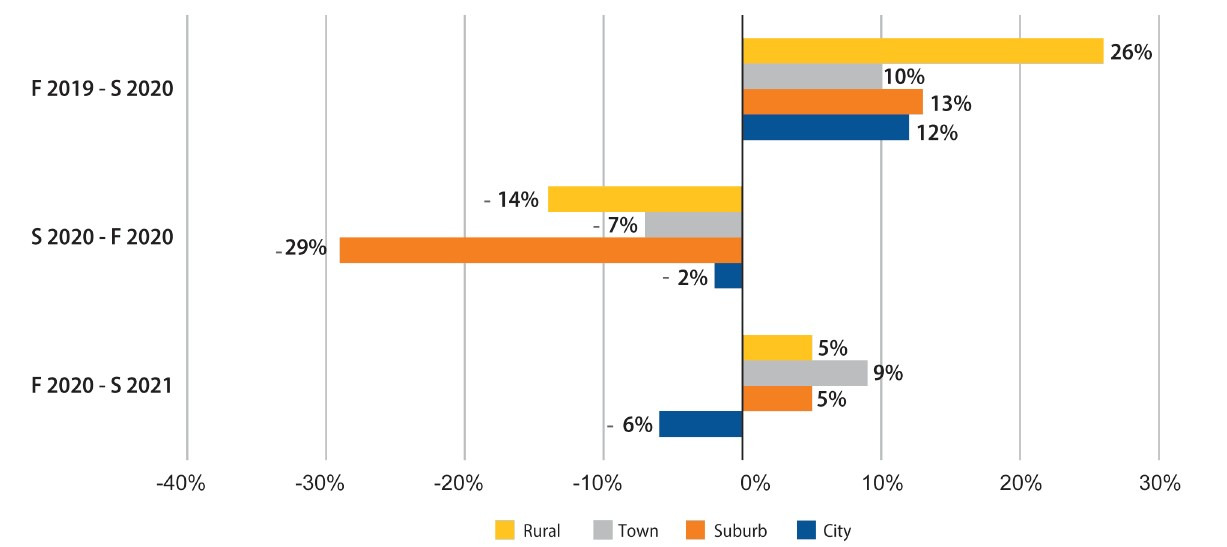
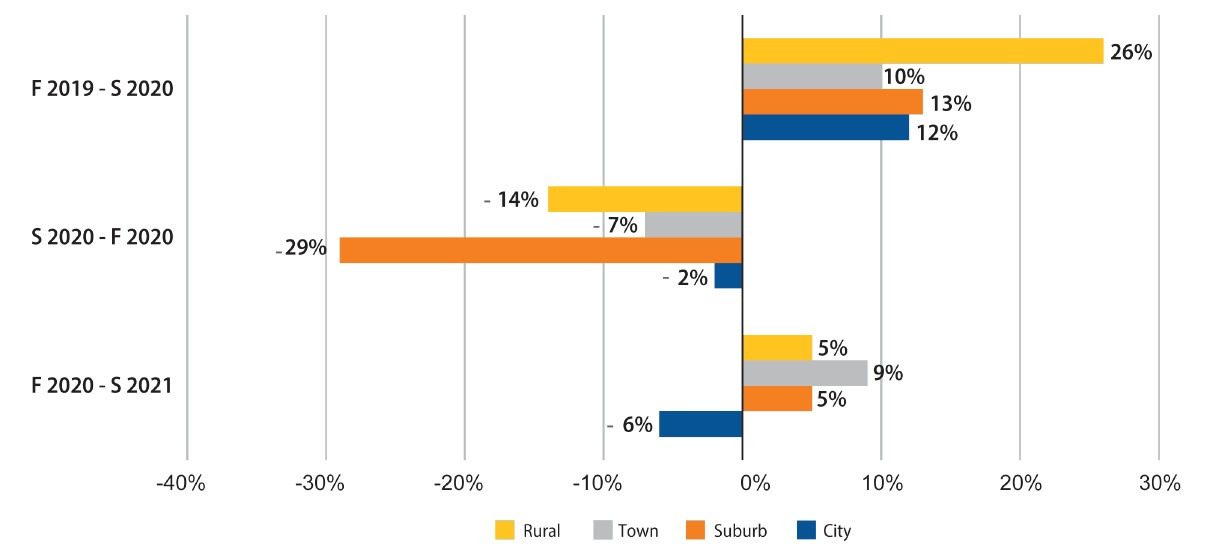
In the term before the COVID-19 pandemic (fall 2019 to spring 2020), enrollment of students in rural schools had increased (212 to 268, a 26.4 percentage point increase). Schools in all locales had an enrollment decline in fall 2020. Although suburban schools had the highest number of students enrolled in every term, they also experienced the steepest decline in enrollment from spring 2020 to fall 2020. City schools had the smallest decline in enrollment from spring 2020 to fall 2020 with a 2.3 percentage point decrease, but their enrollment continued to decline into the next term.
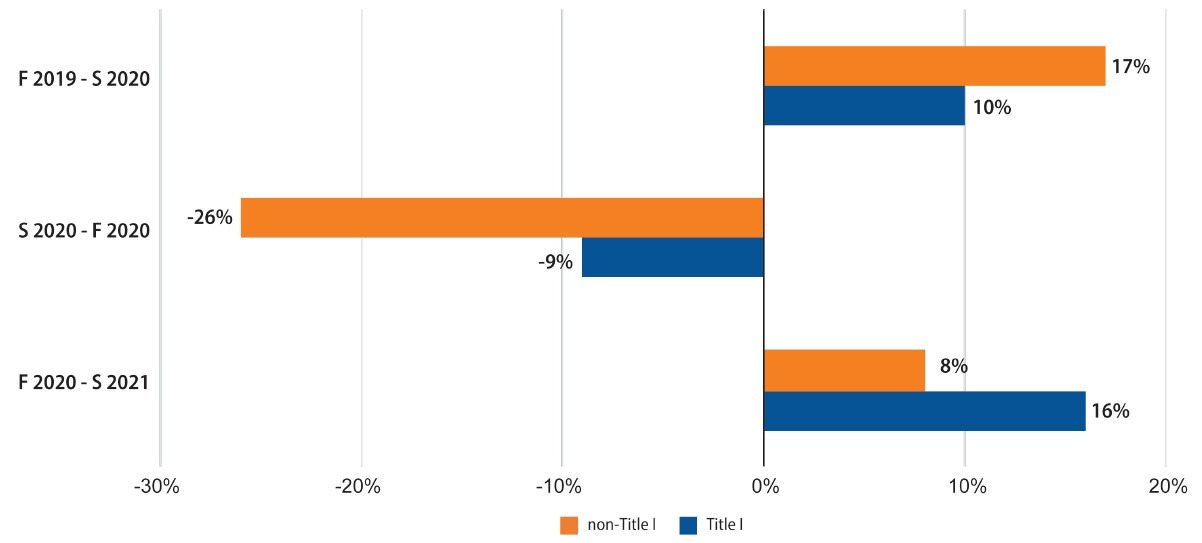
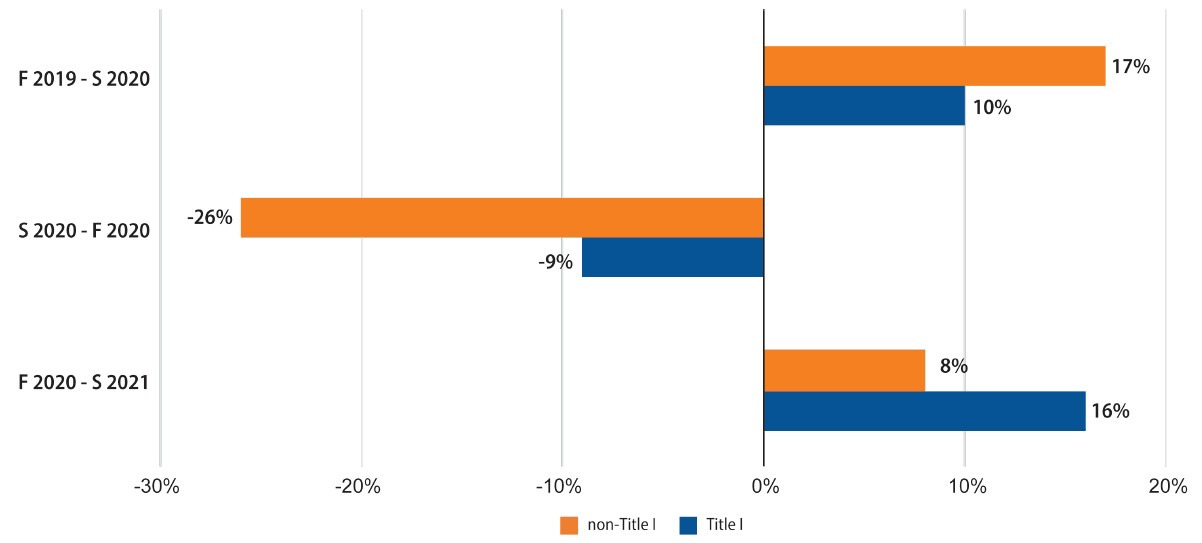
Consistent with the overall results, dual credit course enrollment in Title I and non–Title I schools decreased between spring 2020 and fall 2020. However, students in Title I schools had a smaller decline than their peers in non–Title I schools. From spring 2020 to fall 2020, enrollment declined 9 percentage points for students in Title I schools (1,154 to 1,056) compared with 26 percentage points (1,388 to 1,023) in non–Title I schools. The smaller decline seen in Title I schools between spring 2020 and fall 2020 could reflect the trend of Title I schools also seeing a decline in enrollment before the COVID-19 pandemic. Title I schools saw a 15.5 percentage point drop between spring 2019 and fall 2019 (1,243 to 1,050).
Further breaking out the C or better success measure by student gender, school locale, and Title I status showed some statistically significant differences in success rates over time (Table 2). From spring 2019 to spring 2020, male students had a statistically significant 4 percentage point drop in the rate of earning a C or better whereas female students did not ever have a statistically significant change in their rates of earning a C or better. Rural schools saw the sharpest decline in success, with a statistically significant 10.9 percentage point drop in the rate of students earning a C or better between spring 2019 and spring 2020, indicating students in rural schools were the most impacted by the COVID-19 pandemic. Students in rural schools may have faced more challenges with internet connectivity. A participant in one of our focus groups acknowledged that the COVID-19 pandemic exacerbated barriers among students, specifically rural students who did not have strong, reliable internet connections.
Although students in Title I schools had a smaller decline in enrollment than those in non–Title I schools, the transition to online learning had a greater effect on their course success rate. Title I schools had a statistically significant drop from spring 2019 to spring 2020 and again from fall 2019 to fall 2020 whereas non–Title I schools had no statistically significant differences in the rates of earning a C or better between semesters at any time.
Enrollment Rebound
All groups rebounded to some extent by spring 2021, and for many, enrollment numbers in spring 2021 were close to what they had been before COVID-19. Figures 3a, 3b, and 3c highlight the term-to-term enrollment changes. In each chart, the first bar (fall 2019 to spring 2020) shows enrollment changes in the terms before the pandemic. The second bar (spring 2020 to fall 2020), shows enrollment changes during the COVID-19 lockdown, and the bar for fall 2020 to spring 2021 shows enrollment changes in the term following the lockdown.
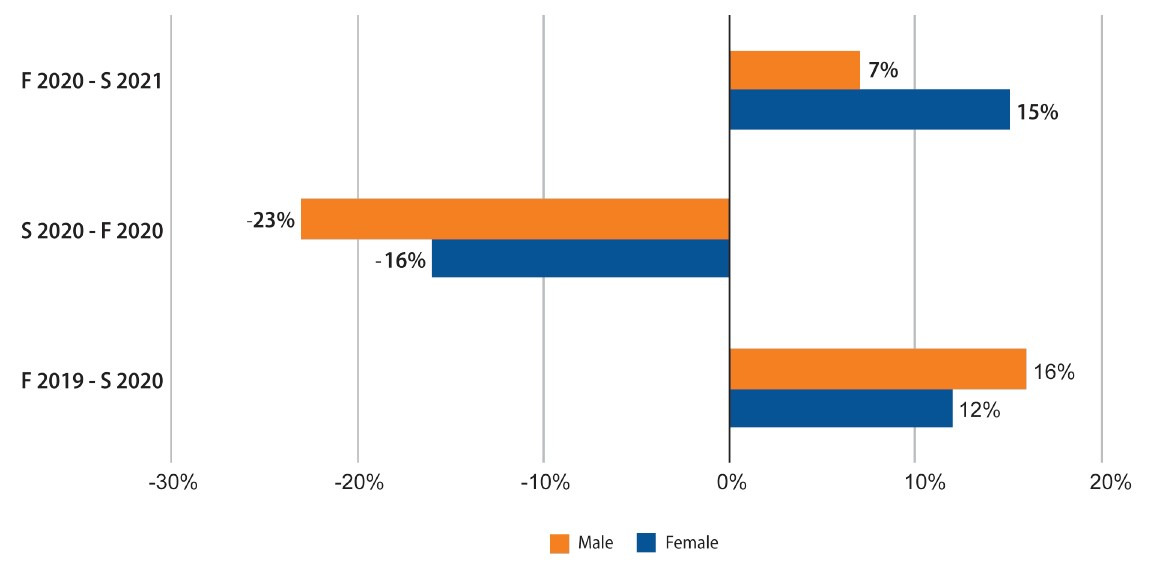
As shown in Figure 3a, enrollment increased for both male and female students from fall 2020 to spring 2021, the terms after the COVID-19 lockdowns, but female students’ enrollment increased by 15 percentage points compared with only 7 percentage points for male students. Male students had a steeper enrollment decline between spring 2020 and fall 2020, but by spring 2021 their number was about the same as it had been before the COVID-19 pandemic began.
When broken out by locale (Figure 3b), all locales except city schools had an increase in enrollment from fall 2020 to spring 2021. In general, the enrollment numbers in spring 2021 were about the same as they had been in spring 2019 (Table 1). Although city school enrollment continued to decline from fall 2020 to spring 2021, these numbers were still higher in spring 2021 (352) than they had been in spring 2019 (286) because their enrollment numbers had increased so much from spring 2019 to spring 2020. Suburban schools had the steepest percentage point decline in enrollment from spring 2020 to fall 2020, but they fully recovered by spring 2021. In rural schools, 243 students enrolled in spring 2021 compared with 245 students in spring 2019. In town schools, 621 students enrolled in spring 2021, and this count was slightly lower than in spring 2019 (642).
Dual credit course enrollment in Title I and non–Title I schools rebounded in spring 2021 (Figure 3c). Enrollment numbers in 2021 for both groups were similar to enrollment counts in 2019 (Table 1).
Rebound in Course Success, by Group
When looking at rates of success in earning dual credit between spring 2020 and spring 2021 by gender, only male students had a statistically significant increase in the rate of earning a C or better (Table 2). Male students saw a 4.9 percentage point increase between spring 2020 and spring 2021, whereas female students only saw a 1.5 percentage point increase. However, as noted earlier, female students had no statistically significant decline in earning a C or better throughout the COVID-19 pandemic.
Similarly, only Title I schools had a statistically significant increase in the rate of students earning a C or better, with a 3.5 percentage point increase in this rate between spring 2020 and spring 2021. However, only students in Title I schools had statistically significant declines in their success rate during the lockdown year. We found no statistically significant success rates for those in non–Title I schools, indicating that the COVID-19 pandemic had little effect on their success rates. In RTI’s survey of high school program coordinators, 12% of respondents thought that students experienced academic challenges during COVID-19 to a “great extent or a very great extent,” but 28% of respondents thought that students underrepresented in college experienced academic challenges “to a great extent or a very great extent.”
Lastly, only suburban schools saw any statistically significant increase in the rate of students earning a C or better, with a 4 percentage point increase between spring 2020 and spring 2021. This finding is notable because suburban schools saw no statistically significant decrease in this rate between spring 2019 and spring 2020 or between fall 2019 and fall 2020.
Policy Implications
-
Dual credit courses present opportunities for high school students to take college classes, which may better prepare them for traditional college experiences. Effectively administering dual credit courses requires a partnership between the high school and postsecondary institution offering the classes.
-
Before the COVID-19 pandemic, the Hawaiʻi Department of Education and University System had been collaborating effectively to strengthen this program, and course offerings and enrollment had increased.
-
Although dual credit course offerings and enrollment dropped after school lockdowns in spring 2020, dual credit course offerings and enrollment levels had rebounded to pre-pandemic levels a year later (spring 2021). This enrollment rebounded even though 84% of these courses were offered online (Figure 1).
-
The percentage of students succeeding in these courses by earning a C grade or better was about the same in online classes (91% for synchronous; 87% for asynchronous) as in face-to-face classes (88%, Figure 2) These findings suggest that instructors and students became more comfortable with the online format.
-
Online instruction may create more opportunities for students to participate in dual credit courses. As noted in focus groups (described in “Differences in Response to the Transition to Online Learning by Student and School Characteristics”), providing online dual credit courses reduces travel burdens that emerge when faculty must go to the high school to teach or high school students must go to the college to learn. Removing this burden may expand the number of courses postsecondary institutions can offer and the number of students choosing to enroll.
-
However, access to online courses can only be scaled up if barriers to internet connectivity are resolved. Focus group participants noted that economically disadvantaged and rural schools may face greater challenges in accessing online courses.
-
Throughout the pandemic period, most students succeeded in earning both high school and college credit by making grades of C or better (Table 2).
-
In surveys (described in the introduction), both high school and college staff reported that college instructors notified the high schools if students were struggling in their class. This kind of communication is essential for students to succeed in the dual credit program.
-
However, some groups of students experienced a statistically significant decline in earning dual credit during COVID-19 (Table 2). They may have needed more support in the online environment. High school and college instructors should collaborate to specify the skills students need to succeed in online courses and develop strategies for students who are underprepared to take online classes.
-
When high school students take courses from college instructors, students need to connect directly with those instructors. In online courses, students may need more assistance creating their schedules, connecting to faculty, and seeking help when they encounter difficulties in class. High school staff can designate a person whom students can contact for assistance to ensure that students understand the responsibilities of the college instructor and high school staff.
Acknowledgments
The original study for this paper was funded by the Research Corporation of the University of Hawaiʻi. We are grateful for that support and for the ongoing guidance we received from Nicole Atwood, Early College Program Director at the University of Hawaiʻi, and Wendy Vincent, Program Manager of Early College at the Hawaiʻi State Department of Education. Student administrative data for this report were provided by the Hawaiʻi Data eXchange Partnership (DXP ID 761). Additionally, we would also like to thank Laurie Baker of RTI International and Jessica Robles of the Bill & Melinda Gates Foundation for their input and guidance on this work.
RTI Press Associate Editor: Karen Keaton Jackson