
Background
Myalgic encephalomyelitis/chronic fatigue syndrome (ME/CFS) is a complex and debilitating disease of unknown etiology that is estimated to affect approximately 1.3% of adults (about 3.3 million individuals) in the United States (Vahratian et al., 2023). ME/CFS is characterized by substantial functional impairment accompanied by severe fatigue, cognitive impairment, unrefreshing sleep, orthostatic intolerance, and post-exertional malaise (Deumer et al., 2021; Institute of Medicine, 2015; Osoba et al., 2007). Although the etiology of the disease remains unknown, numerous studies support the hypothesis that ME/CFS may be triggered by a viral infection (Ariza, 2021; Blomberg et al., 2018; Choutka et al., 2022; Hanson, 2023; Santa et al., 2018), including recent evidence suggesting that the risk of developing ME/CFS increases following SARS-CoV-2 infection (Vernon et al., 2025). Studies have shown that ME/CFS is associated with irregularities across multiple body systems, including disruptions in immune function, protein signaling, metabolism, and gene expression (Germain et al., 2017, 2020, 2021; Hornig et al., 2015, 2017; Keele et al., 2026). Although several potential biomarkers for ME/CFS have been investigated, none have been validated for reliably distinguishing individuals with ME/CFS from healthy controls in clinical settings (Maksoud et al., 2023). In addition, there are currently no treatments for ME/CFS approved by the U.S. Food and Drug Administration, though experienced clinicians have reported off-label use of several therapies that appear to benefit many patients (Bateman et al., 2021).
Investigators with hypotheses relevant to ME/CFS can benefit from access to a biorepository of biospecimens and associated data from individuals with ME/CFS and matched healthy controls. Despite the number of individuals with this debilitating disease, few ME/CFS-specific biorepository resources exist (Emerge Australia, n.d.; Lacerda et al., 2018; Pheby et al., 2011; Ramiller et al., 2022). Although large volumes of biospecimens are often collected across ME/CFS and other research settings, many remain unused because of limited visibility and coordinated infrastructure to support investigator access (Bledsoe & Sexton, 2019; Paradiso et al., 2018). This underutilization has been identified as an ethical concern, reflecting a responsibility to ensure that collected specimens and associated data are used for scientific and public benefit (Cadigan et al., 2014). Facilitating secondary use of existing biospecimens and associated data is therefore essential to maximizing scientific value for ME/CFS research while streamlining the research process, reducing costs, and accelerating the pace of discovery (Bukreeva et al., 2024). Recognizing these challenges and opportunities, the ME/CFS Research Network’s (Myalgic Encephalomyelitis/Chronic Fatigue Syndrome Research Network (MECFSnet), n.d.) Data Management and Coordinating Center (DMCC) at RTI International developed searchMECFS (searchMECFS, n.d.-a), a free, interactive online resource to facilitate secondary use of ME/CFS biospecimens and associated data. searchMECFS supports the ME/CFS research community by enabling researchers to query two U.S. government–funded ME/CFS biorepositories using available demographic, clinical, and biospecimen data in order to assess the availability of biospecimens in support of their research.
Methods
Overview and Technical Design
In 2017, multiple institutes within the National Institutes of Health funded the ME/CFS Research Network (Myalgic Encephalomyelitis/Chronic Fatigue Syndrome Research Network (MECFSnet), n.d.), comprising three Collaborative Research Centers and a DMCC to advance ME/CFS research. The goal of the Network is to strengthen collaborative research and promote data sharing to improve the understanding of ME/CFS diagnosis and treatment. The DMCC developed two complementary data-sharing tools that use de-identified data: searchMECFS (searchMECFS, n.d.-a), an online ME/CFS biospecimen search resource, and mapMECFS (Mathur et al., 2021), an interactive data portal that provides access to results across many biological disciplines from research focused on advancing our understanding of ME/CFS. searchMECFS enables researchers to identify and request available biospecimens and associated data for laboratory analyses, and the corresponding full clinical datasets are maintained in mapMECFS (searchMECFS, n.d.-a). searchMECFS was designed to let researchers use query results for initiating applications to the National Institute of Neurological Disorders and Stroke (NINDS) Biospecimen Resource Access Committee (BRAC), an external scientific review panel, to request biospecimens of interest free of charge. In-depth clinical data associated with these biospecimens are then made available to BRAC-approved researchers through mapMECFS.
searchMECFS System Design
searchMECFS is securely hosted on the Microsoft Azure App Service cloud platform. The site’s intuitive design allows researchers to search for available biospecimens based on sample type and participant characteristics. To accomplish this, the user interface and query functionality are built on a base of .NET Core 2.1 (Microsoft, n.d.-b) with WebAPI. It integrates the use of HTML 5, JavaScript, Typescript, jQuery v3.3.1 (openjsf.org, OpenJS Foundation, n.d.-a), and jQuery UI v1.12.1 (openjsf.org, OpenJS Foundation, n.d.-b) and leverages the Bootstrap front-end framework v3.4.1 (Otto & Thornton, n.d.). To ensure privacy and confidentiality, all system data are stored in a Microsoft SQL Server database (Microsoft, n.d.-a), with encryption at rest implemented as a key security measure to prevent unauthorized access in case of system breaches. The searchMECFS hosting platform is fully compliant with the security and regulatory standards defined in Federal Information Processing Standard 199 (National Institute of Standards and Technology, 2004), as set forth in the Federal Information Security Modernization Act of 2014 (Cybersecurity & Infrastructure Security Agency, n.d.).
Data are stored in database tables optimized for use by the searchMECFS system, enabling efficient querying and retrieval of biospecimen inventory. The query tool, built on v2.5.2 of the jQuery QueryBuilder plugin (jQuery QueryBuilder, n.d.), allows users to construct customized searches through an intuitive interface. As users build queries, the system generates a human-readable, exportable query statement to help users understand their search structure and results. Query search results are exportable as comma-separated values (CSV) files to facilitate further analysis. To ensure up-to-date and accurate inventory information, sample inventory data are securely transferred from the appropriate biorepositories and updated following each fulfilled request.
Participating Studies
searchMECFS currently hosts biospecimen and select clinical data from two studies: the Chronic Fatigue Initiative (CFI) Study (Klimas et al., 2015) and the Multi-Site Clinical Assessment of ME/CFS (MCAM) (Unger et al., 2017). Both studies recruited individuals with ME/CFS and healthy controls, used standardized questionnaires to assess overall functioning and ME/CFS symptoms, and collected biospecimens for future hypothesis testing.
Chronic Fatigue Initiative Study
The CFI Study was established and funded by the Hutchins Family Foundation to advance research into the underlying causes of ME/CFS (Hutchins Family Foundation, 2025). As part of the initiative, individuals with ME/CFS and healthy controls from five U.S. clinical research sites specializing in ME/CFS clinical care were recruited between 2011 and 2013 to participate in the CFI Study (Klimas et al., 2015). The study participants with ME/CFS were aged 18 to 65 years, were diagnosed by a healthcare provider with expertise and experience with ME/CFS, and met at least one of two ME/CFS case definitions: 1994 Fukuda Criteria (Fukuda et al., 1994) or Canadian Criteria (Carruthers et al., 2011; Jason et al., 2010). Healthy controls were aged 18 to 65 years; had no history of ME/CFS or other active illnesses; and were age-, sex-, and geographic location-matched to the ME/CFS study participants (Klimas et al., 2015).
Multi-Site Clinical Assessment of ME/CFS
The MCAM study was conducted in multiple stages by the Centers for Disease Control and Prevention (CDC), in collaboration with ME/CFS specialty clinics, from 2012 to 2020 (Fall et al., 2024; Unger et al., 2017). It was conducted in two major components: (1) an adult longitudinal cohort, and (2) a pediatric longitudinal cohort. The adult cohort also included cognition and exercise testing substudies (Cook et al., 2022; Lange et al., 2024). The adult longitudinal cohort recruited individuals aged 18 to 70 years at their baseline enrollment who had been diagnosed with ME/CFS or post-infectious fatigue or were being managed for ME/CFS by an expert physician. The ME/CFS study participants were not required to fit a specific case definition to be eligible. Healthy controls were participants aged 18 to 70 years with no history of ME/CFS or other active illnesses who were age- and sex-matched to the ME/CFS participants (Unger et al., 2017). During Stage 1 of the study, investigators only enrolled participants with ME/CFS. In subsequent stages, investigators collected follow-up information from those enrolled in Stage 1 and started recruiting healthy controls, as well as newly enrolled ME/CFS participants. Because enrollment happened in multiple stages, each participant’s first study visit could come from any stage of the study. Biospecimens and clinical data were collected at multiple study visits, enabling longitudinal evaluation of participants (Unger et al., 2017). The pediatric longitudinal cohort took place from 2013 to 2020 at four ME/CFS clinics, recruited individuals aged 10 to 17 years, and followed methods similar to those described for the adult longitudinal cohort, but with age-appropriate instruments.
Data De-Identification and Sharing
searchMECFS data-sharing procedures are designed to protect the privacy of all study participants. CFI study participants who provided informed consent for the original study and did not opt out after being notified of the transfer of their biological samples and health data to NINDS were included in data shared on searchMECFS. Similarly, MCAM study participants who consented to sample storage for future research in the original study were included. NINDS and CDC officials were required to sign a Data Use Agreement (DUA) and Data Submitter Agreement to share data on searchMECFS and mapMECFS. NINDS and CDC assigned a de-identified identification number (ID) to each study participant prior to sharing their data with the DMCC. In addition, there are no links directly connecting the biospecimens with a participant’s identity. All clinical data shared on searchMECFS adhere to the “safe harbor” approach to the Health Insurance Portability and Accountability Act for removal of 18 potential participant identifiers (Office for Civil Rights (OCR), 2012). searchMECFS users must sign a DUA during registration agreeing to comply with data access and usage restrictions (searchMECFS, n.d.-b).
Results
Currently, searchMECFS hosts biospecimen information and associated clinical data from two ME/CFS research studies. searchMECFS began hosting biospecimen and clinical data from the CFI Study in 2019 and from the MCAM study in 2024. The demographic characteristics of these studies are outlined in Table 1.
Biospecimen Availability
Details of biospecimen collection and storage have been described elsewhere for both studies (Klimas et al., 2015; Unger et al., 2017). The CFI Study collected specimens from 401 participants, including 201 individuals with ME/CFS and 200 healthy controls. The study collected DNA, RNA, plasma, saliva, serum, urine, peripheral blood mononuclear cells, and tears from all consenting participants. All samples were collected at the first clinical study visit (Klimas et al., 2015). CFI biospecimens were originally housed at Duke University before being transferred to the NINDS-supported biorepository, BioSEND, at Indiana University (BioSEND, n.d.).
searchMECFS hosts biospecimen data from multiple components of the MCAM study: (1) two study visits from the adult longitudinal cohort, (2) one study visit from the adult cohort cognition and exercise substudies, and (3) one study visit from the pediatric longitudinal cohort. For Visit 1 of the adult cohort, samples were collected from 801 participants (459 ME/CFS cases and 343 healthy controls) (Unger et al., 2017). Visit 2 was conducted approximately 10–14 months after Visit 1 and included specimens from 501 participants (346 ME/CFS cases and 155 healthy controls) (Unger et al., 2017). Whole blood, plasma, and saliva were collected during all study visits, and DNA and RNA were isolated from the whole blood samples (Unger et al., 2017). All samples were collected during a clinical study visit except for saliva, which was collected at four time points (0, 30, 45, and 60 minutes post-waking) at the participant’s home using saliva collection kits (Unger et al., 2017). An additional study visit is available for a subset of 426 adult participants (261 ME/CFS cases and 165 healthy controls) who participated in the cognition and exercise substudies (Cook et al., 2022; Lange et al., 2024). It should be noted that most of these participants are also enrolled in the adult longitudinal cohort, though some are not. Among these substudy participants, pre- and post-testing plasma samples are available. One study visit is currently available for the MCAM pediatric cohort. For this cohort, saliva samples are available from 54 participants (25 ME/CFS cases and 29 healthy controls) at the same post-waking time points used in the adult cohort. All MCAM biospecimens are stored in a CDC biorepository.
Because biospecimen availability varies dynamically by phenotype, visit, and prior distribution, detailed sample counts are best assessed through the searchMECFS query interface, which allows investigators to identify specimens that meet specific criteria. In addition, CFI and MCAM biospecimens are stored in separate repositories, resulting in slight differences in their aliquot preparation and shipping procedures. Current storage aliquot sizes and example aliquot sizes for distribution are summarized in Table 2.
Search Parameters for Biospecimen Queries
Participant demographics, select clinical data, and responses to ME/CFS symptom questionnaires can be used as search parameters to refine biospecimen queries. These data elements are grouped into domains of ME/CFS illness characteristics and timing, demographics, lifestyle characteristics, and participant questionnaires. Data from questionnaires that measure patient-reported outcomes of ME/CFS symptoms, quality of life, and well-being are presented as questionnaire-specific summary subscores. Documentation of questionnaire scoring and data modifications is available for download on searchMECFS, along with associated data dictionaries. Table 3 summarizes the questionnaires available for both MCAM and CFI as biospecimen search parameters. This does not represent an exhaustive list of instruments used in each study but includes those available as searchable parameters in the biospecimen query tool.
Example Query Results
searchMECFS provides an intuitive interface for researchers to independently perform complex queries and determine the availability of biospecimens. Users can filter by selected search parameters, as described above, to assess available specimens and quantities from respective biorepositories. Flexible grouping of search parameters allows for tailored, detailed queries. An example query for ME/CFS samples from the CFI Study is shown in the Supplemental Information Figure S1. Query results, provided as an exportable CSV file, include a standard set of output variables, including a de-identified participant ID, case/control status, sex, age, specimen types, and available specimen quantities. These results can be submitted with applications to the NINDS BRAC to request biospecimens of interest.
Requesting Biospecimens Using searchMECFS
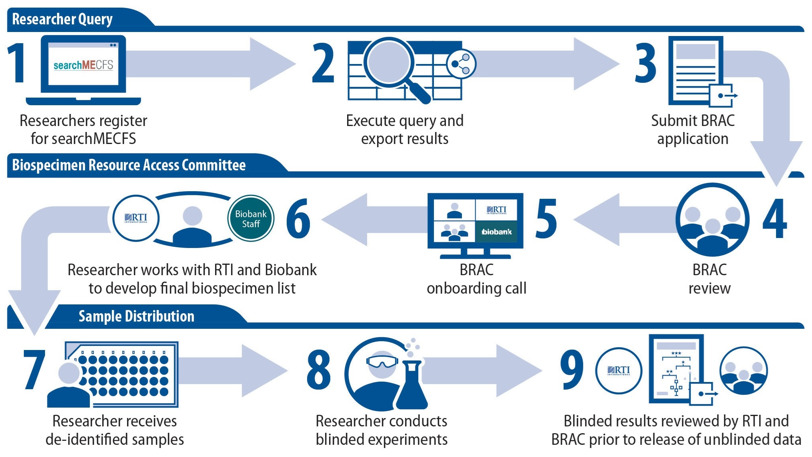
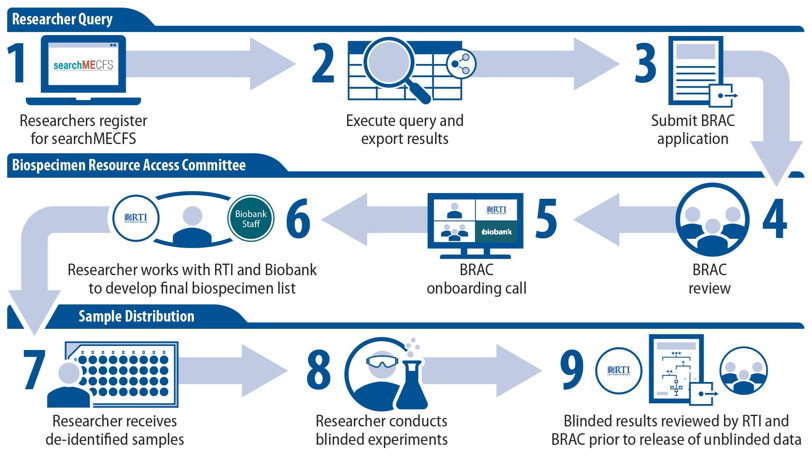
The workflow to query for biospecimens using searchMECFS and request those of interest is summarized in Figure 1. Researchers interested in requesting biospecimens must register on searchMECFS, complete a registration form, and agree to the terms outlined in the searchMECFS DUA. The registration is reviewed and approved by the DMCC. Once a registration is approved, researchers can access searchMECFS to select a study of interest (i.e., CFI, MCAM) and use search parameters to query biospecimen availability. After identifying suitable biospecimens, researchers can submit an application to the NINDS BRAC through the BioSEND website (BioSEND, n.d.).
The BRAC evaluates applications based on the experimental rationale, assay feasibility and reproducibility, the investigator’s expertise, institutional resources and funding available to support the study, and the statistical analysis and scientific justification of the sample size needed for hypothesis testing. Approved applicants participate in a virtual onboarding meeting to finalize sample selection, preparation, and shipping logistics. Biospecimens that are de-identified and blinded to case/control status are then distributed to researchers by the relevant biorepository. After completing initial blinded experiments, researchers share these data with the DMCC and NINDS program staff for review to document assay completion before receiving the sample unblinding file. Researchers are required to upload the final results of their study to mapMECFS (Mathur et al., 2021) to promote data sharing within the broader research community.
Case Study
To demonstrate the utility of searchMECFS, we highlight a 2023 study where secondary use of biospecimens and associated data were used to examine cellular circadian rhythm disruption in ME/CFS (Wei et al., 2023). The researcher used searchMECFS to identify 40 serum samples (20 ME/CFS cases and 20 controls) from the CFI Study that satisfied the following inclusion criteria based on available clinical data: participants aged 18 to 65 years, a primary infection-related onset of ME/CFS, a diagnosis of ME/CFS by a healthcare provider, and a Pittsburgh Sleep Quality Index sleep severity score of greater than 6. The study demonstrated that circadian rhythm in peripheral cells may be impacted by ME/CFS serum factors and symptoms related to ME/CFS, such as insomnia (Wei et al., 2023).
Discussion
Although large numbers of biospecimens have been collected for ME/CFS research, improving their visibility and accessibility for secondary use represents a significant opportunity to expand scientific impact and accelerate discovery. searchMECFS advances this opportunity by making existing ME/CFS biospecimens and associated data more discoverable and accessible to investigators. searchMECFS facilitates secondary use of ME/CFS biospecimens and associated data by (1) hosting data from two large ME/CFS cohorts (CFI and MCAM); (2) offering researchers a centralized resource to query biospecimen data using participant demographics and questionnaires that measure patient-reported outcomes of ME/CFS symptoms, quality of life, and well-being; (3) providing flexible and intuitive search parameters that let investigators identify suitable biospecimens for hypothesis-driven research; (4) facilitating applications to NINDS BRAC for access to biospecimen resources free of charge; and (5) promoting sharing of experimental data with the broader research community through mapMECFS.
Because searchMECFS hosts biospecimens from multiple studies, there are some limitations to consider. First, it is possible that some participants were enrolled in more than one study, and participant overlap cannot be assessed. Thus, to avoid inadvertent duplication of participants in analyses, requesting biospecimens from more than one study is not recommended. In addition, the CFI and MCAM studies used different symptom assessments and diagnostic criteria, so any cross-study comparisons should be interpreted with caution.
searchMECFS was successfully used to request ME/CFS biospecimens for original research, which generated novel insights into potential biological mechanisms underlying ME/CFS symptoms (Wei et al., 2023). The site’s well-characterized inventory of biospecimens has the potential to support a variety of hypothesis-driven projects from early-career investigators to established researchers. searchMECFS is available to the scientific community with registration, as described above. ME/CFS researchers are encouraged to explore searchMECFS and identify biospecimens that align with their study needs. The DMCC plans to expand sample availability in the future, including additional MCAM biospecimens and clinical data.
Conclusion
searchMECFS enables investigators to independently identify well-characterized biospecimens and associated demographic and clinical data from ME/CFS studies. By simplifying the biospecimen discovery and application process, this resource supports novel ME/CFS research, encourages resource sharing and collaboration within the ME/CFS research community, and facilitates secondary use of valuable ME/CFS bioresources. Improved visibility and accessibility through searchMECFS will help maximize the scientific value of existing ME/CFS biospecimens. We invite investigators to visit the searchMECFS website and explore available samples to support their research.
Data Availability Statement
The searchMECFS biospecimen search tool is open to the research community at https://searchmecfs.org/.
Authors’ Contributions
Quinn Barnette and Keith LeGrow led the writing of this work. Mr. Barnette and Michael Ham are the data management and development leads for searchMECFS. Dóra Illei and Stephanie N. Giamberardino are technical staff working on the development of searchMECFS. Linda M. Brown and Megan U. Carnes are the co–Principal Investigators on the ME/CFS DMCC and advised the development of searchMECFS. All authors edited and reviewed the manuscript.
Supplementary Information
An example searchMECFS query output for the CFI Study is provided in the Supplementary Information Figure S1: https://doi.org/10.5281/zenodo.22132889.
Acknowledgments
The authors thank all members of the ME/CFS Research Network who contributed to the development of searchMECFS.
Research reported in this publication was supported by the National Institute of Neurological Disorders and Stroke of the National Institutes of Health under Award Number U24NS105535. The content is solely the responsibility of the authors and does not necessarily represent the official views of the National Institutes of Health.